
Reviewed · ICE CLIMBING
Micro group – Ice climbing at Sólheimajökull
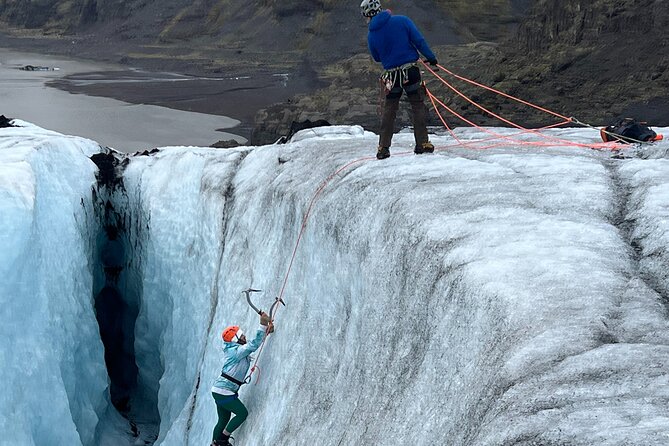
Sólheimajökull ice climbing gives you more than a look at a glacier from a roadside viewpoint. You walk onto the ice, cross crevasses and moulins, then learn how to place your feet and use your axes on a real climbing route. The group is capped at four people, which gives the guide room to adjust the outing to your pace.
I like the small-group format and the chance to try different levels of difficulty during the four-hour outing. I also like that the price includes the technical gear you need: crampons, ice axes, a harness, and a climbing belt. The main catch is practical: boots and clothing are not included, and you need a moderate level of physical fitness.
Key points at a glance
- Four-person maximum: You get more instruction and less waiting than on a large glacier walk.
- A 15-minute approach: The outing starts at the Sólheimajökull parking area, followed by a walk to the glacier tongue.
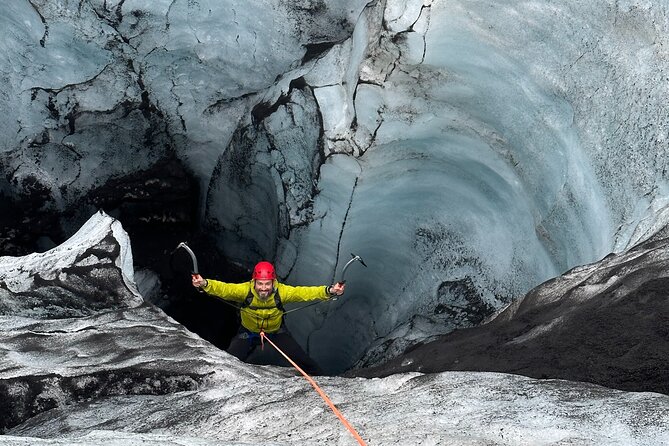
- Real ice climbing: You may climb a crevasse or moulin after learning basic movement and safety techniques.
- Technical equipment included: Crampons, ice axes, a harness, and a climbing belt are supplied.
- Four hours on the schedule: The length allows time for instruction, exploration, and more than one climbing location.
- Boots and clothing are your responsibility: Plan your gear carefully before arriving.
Why Sólheimajökull ice climbing is different
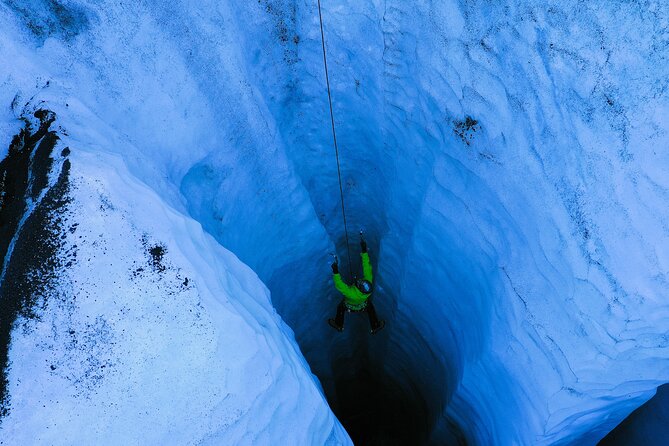
Many glacier outings let you walk across the ice and take photographs. This one asks you to use the glacier in a more active way. You do not simply follow a marked route. After the approach, your guide looks for a suitable crevasse or moulin where you can practice climbing.
That makes the outing feel more personal and hands-on. You learn how your crampons grip the ice, how an ice axe supports your movement, and how your body position affects each step. The guide first explains the technique, then helps you apply it on the glacier.
A moulin is a channel or shaft formed when meltwater runs into the glacier. Crevasses are cracks in the ice, and both features can offer different climbing challenges. The exact spot depends on conditions and the guide’s judgment, so you should expect an adaptable outing rather than a fixed climbing wall.
The glacier itself supplies much of the drama. You move across blue-white ice, around cracks and channels, with the surface changing as you go. The activity is not only about reaching the top of a route. It is about learning to read and move across a glacier in a controlled setting.
More Ice Climbing in the South Coast
- Sólheimajökull Glacier Hike & Ice Climbing Intro – Small Group
★ 4.5 · 151 reviews - Sólheimajökull Ice Climbing and Glacier Walk
★ 5.0 · 132 reviews - Sólheimajökull Ice Climb and Glacier Hike
★ 4.9 · 67 reviews
The 15-minute walk from the parking area
You meet at the Sólheimajökull parking area, at Sólheimajökull, 871, Iceland. From there, the group walks for about 15 minutes toward the glacier tongue.
That approach is short, but it matters. You are not stepping out of a vehicle directly onto the climbing area. You need to carry or wear what you bring for the activity, and your clothing should be ready for a walk over uneven ground and changing weather.
The walk also gives the guide time to gather the group and prepare you for the glacier. Once you reach the ice, the guide provides a safety briefing and helps you put on the technical equipment. Give yourself enough room in your schedule to arrive at the meeting point ready to start, rather than treating the listed four hours as a door-to-door time from your accommodation.
The end point is the same as the meeting point. There is no separate transport segment included in the activity details, so plan your route to and from the Sólheimajökull parking area yourself.
Safety briefing and gear on the glacier
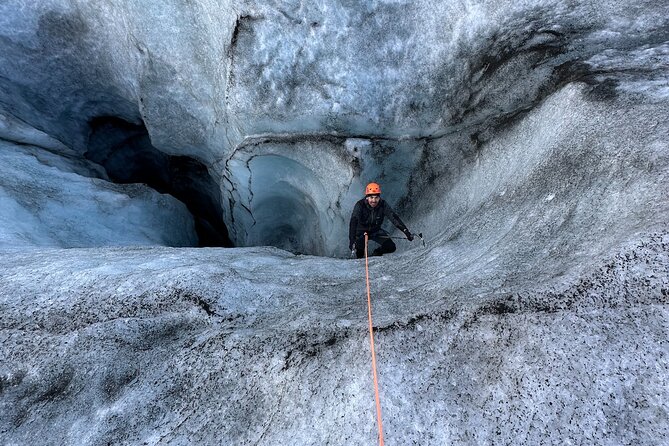
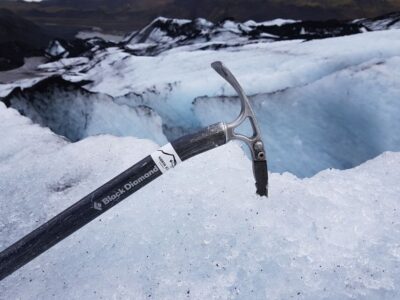
The technical equipment supplied includes a climbing belt, ice axes, a harness, and crampons. These are the pieces that make the activity possible. Crampons give your boots points for gripping the ice, while the axes help you balance and move on steeper sections.
The harness and climbing belt are part of the safety setup. Your guide explains how the equipment works and helps you gear up before climbing. This is an important part of the outing, not a formality to rush through. You should pay close attention, especially if you have never used crampons or ice axes before.
The guide also explains how to move on the ice. That instruction is valuable because ordinary walking habits do not always work well with crampons. You need to place your feet with care and coordinate your hands and feet with the tools.
Bring your own clothing and boots. The supplied equipment does not replace warm, protective clothing, and the tour details do not state that footwear is provided. You should treat suitable boots as essential, not optional. The same goes for clothing that can handle a cold, wet, exposed outdoor setting.
Because specific clothing requirements are not given, check the current instructions from Hyperborea Tours before you go. The key point is simple: the technical climbing kit is covered, but your personal clothing system is not.
Crossing crevasses and moulins before the climb
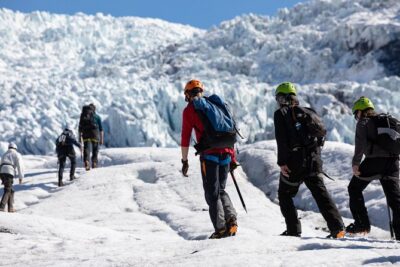
Once you are equipped, you cross sections of the glacier until the guide finds a suitable climbing location. The route may include crevasses and moulins, which is one of the most interesting parts of the outing.
This movement across the glacier gives you a sense of how varied the ice can be. One area may be broad and easy to cross, while another may be shaped by cracks, channels, or steep walls. The guide chooses where to go based on the conditions and the group.
The exact route is not fixed in the supplied details, and that is worth understanding before booking. You are not promised one named crevasse or a specific climbing wall. Instead, the guide can explore different places during the day and choose suitable options.
That flexibility is a strength. Glacier conditions change, and a fixed route would not necessarily be the best or safest choice on every date. It also means you should arrive with an open mind. The final climbing area may differ from what you picture.
More Ice Climbing in Vik:
- Skaftafell National Park: Falljokull Ice Climb and Hike
★ 4.7 · 78 reviews - Small-Group Ice Climbing and Glacier Hiking in Solheimajokull
★ 4.5 · 21 reviews - Private Ice Climbing on Sólheimajökull
★ 5.0 · 3 reviews - Exclusive Ice Climbing Experience on Sólheimajökull
★ 5.0 · 3 reviews
Learning the basic technique
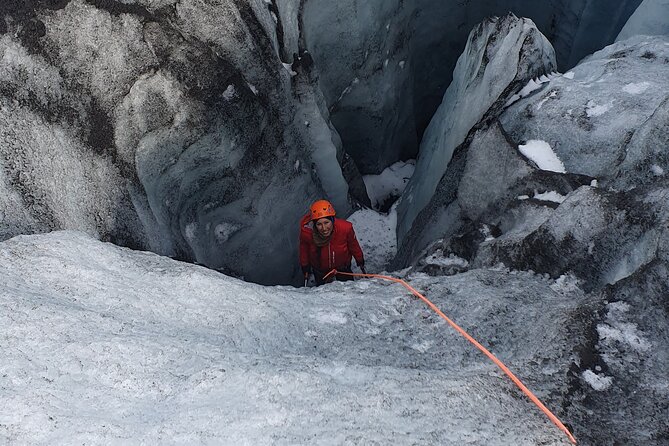
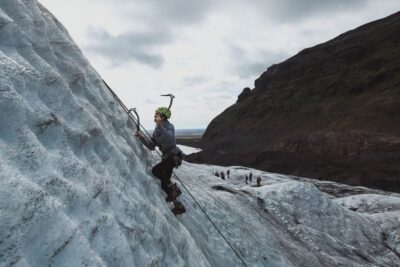
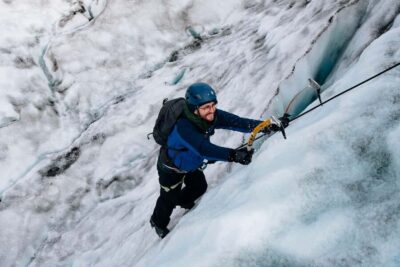
At the climbing site, the guide goes over technique again and explains how to move on the ice. You then try climbing a crevasse or moulin, with the guide directing the group.
The instruction is aimed at helping you get more from the time on the glacier. You are not expected to arrive as an experienced climber. The activity is designed around learning the basic movements and then trying them in different settings.
I like the progression here. You first receive a safety briefing, then get fitted with equipment, then cross the ice before attempting a climb. Each step gives you a little more information before the physical challenge begins.
The guide can also offer different levels of difficulty during the day. That matters in a group of four because the outing can respond to the people taking part. If you are new to ice climbing, you can focus on the basics. If you are comfortable and the conditions allow it, you might try a more demanding section.
The information does not promise a particular height, route grade, or number of climbs. Keep your expectations realistic. The value is in receiving instruction and trying suitable ice features, not in collecting a guaranteed list of technical achievements.
A four-hour outing with room to adjust
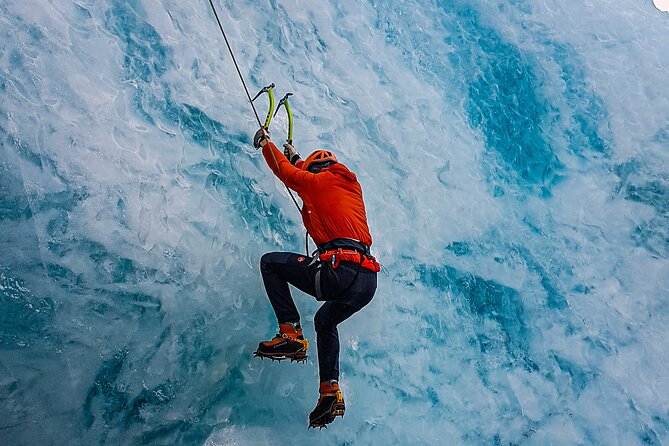
The activity lasts about four hours. That is a useful length for a first ice-climbing session because it leaves time for the walk, safety talk, equipment fitting, instruction, climbing, and movement between locations.
A shorter outing could feel rushed once the guide has finished explaining the equipment. Here, the extra time allows you to settle into the crampons and axes instead of making one quick attempt and heading back.
The schedule is also long enough for the guide to explore different climbing areas. You may have the opportunity to try more than one level of difficulty, depending on the day’s conditions and the group’s ability.
Still, four hours on or around a glacier is a physical commitment. The activity requires moderate physical fitness. You should be comfortable walking to the glacier, crossing uneven ice, standing in climbing equipment, and repeating the movement practice.
The tour is limited to a maximum of four people. This is one of its strongest features. A small group means less time spent waiting for several dozen people to gear up or take a turn. It also gives the guide a clearer sense of what each person can handle.
What the $260 price means
At $260 per person, this is not a cheap add-on to a day in southern Iceland. It is a specialist activity with a small group, technical equipment, instruction, and about four hours of guide time.
The price makes more sense if you value direct coaching and a small group. A four-person maximum is costly for an operator because the guide is working with only a few people, but it gives you a better chance to ask questions and get repeated practice.
The included gear also adds value. You do not need to arrange your own crampons, ice axes, harness, or climbing belt. Those are not casual items that most visitors carry in Iceland.
The price does not cover boots or clothing, so add those costs if you need to rent or buy anything before the outing. The available information does not give rental details, so contact Hyperborea Tours if you are unsure about what your own gear must meet.
For an active half-day with a four-person limit, the price can be reasonable for the right person. It is less attractive if you only want a simple glacier walk or do not enjoy physical instruction. You are paying for participation, not just scenery.
Who should book this activity
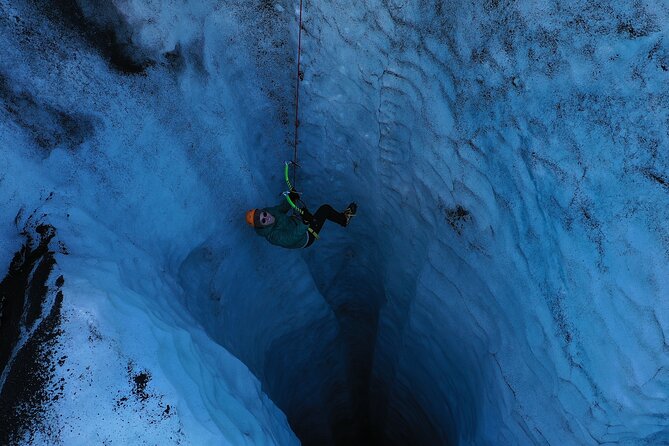
I would recommend this outing to you if you want to do more than photograph Sólheimajökull. It suits someone who likes learning a new outdoor skill and does not mind being active in cold conditions.
It is also a good fit if you value personal attention. The maximum of four people is unusually small, and the guide can adjust the route and difficulty as the day develops.
You do not need to be an advanced climber based on the information provided. The guide explains the techniques and shows you how to move on the ice. Still, you need moderate physical fitness and must be ready to follow safety instructions closely.
I would think twice if your main goal is a relaxed walk with little exertion. You should also reconsider if you do not have suitable boots and clothing, since those are not supplied.
The outing is offered in English. Confirmation arrives when you book, and the activity normally sells about eight days before its date. That does not guarantee availability, but it suggests that waiting until the last minute may not be wise, even though one couple was able to book shortly before going and had a good time.
Weather, flexibility, and cancellation
Good weather is required for this activity. If poor weather causes a cancellation, you are offered another date or a full refund.
That weather rule is sensible for a glacier activity. Conditions affect the approach, the climbing area, and the safety of working around crevasses and moulins. A cancellation can disrupt your plans, so avoid placing this outing at the very end of a tight Iceland schedule if you can.
You can cancel for a full refund up to 24 hours before the start time. Changes or cancellations made less than 24 hours before the local start time are not accepted for a refund.
My final call on Sólheimajökull ice climbing
Book it if you want a real introduction to glacier climbing, prefer a small group, and are prepared to supply your own boots and clothing. The combination of technical equipment, instruction, four hours, and a four-person limit gives the $260 price a clear purpose.
Skip it if you want a low-effort glacier visit or if moderate physical activity is not for you. For the right person, this is a focused and memorable way to meet Sólheimajökull, one crevasse, one moulin, and one carefully placed crampon step at a time.
FAQ
Where does the ice-climbing activity start?
It starts at the Sólheimajökull parking area, at Sólheimajökull, 871, Iceland.
Where does the activity end?
It ends back at the meeting point.
How long does the activity last?
The activity lasts approximately four hours.
How large is the group?
The maximum group size is four people.
What equipment is included?
The activity includes a climbing belt, ice axes, a harness, and crampons.
Are boots and clothing included?
No. You need to provide your own boots and clothing.
What happens if the weather is too poor for the activity?
If poor weather causes a cancellation, you are offered a different date or a full refund.
Just added around Vik
- Vik: Guided Sólheimajökull Glacier Hike★ 4.7 · 233 reviews
- Thorsmork Hike Day Tour★ 5.0 · 79 reviews
- Private Day Trip in Landmannalaugar South Region area on a 4×4 truck★ 5.0 · 7 reviews
- Thorsmork by Super Jeep with Optional Hike★ 5.0 · 74 reviews
- Private Thorsmork Day Hike by Super Jeep★ 5.0 · 7 reviews
- Ancient Historical Site Tour at the Caves of Hella★ 4.5 · 191 reviews
- Tandem Paragliding Flights from Vik★ 5.0 · 63 reviews
- Sólheimajökull Glacier Hike Adventure★ 5.0 · 8 reviews
Ice Climbing, compared.
Sólheimajökull Glacier Hike & Ice Climbing Intro
Read our review →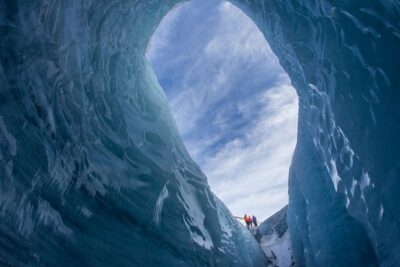
Sólheimajökull Glacier Hike & Ice Climbing Intro – Small Group
Read our review →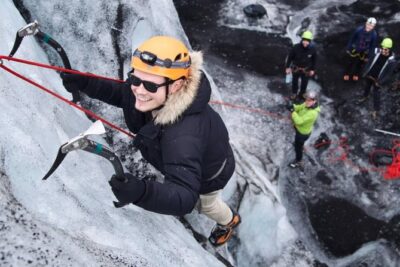
Skaftafell National Park: Falljokull Ice Climb and Hike
Read our review →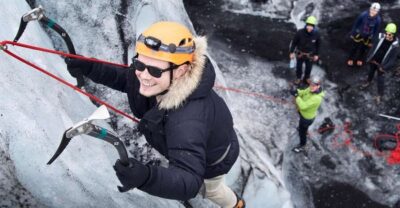
Browse the lists this tour appears in